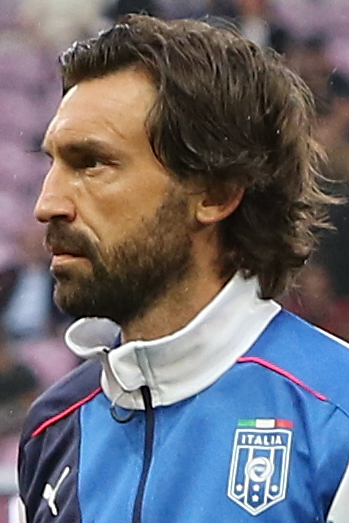
There is a photograph that will be difficult to forget. Andrea Pirlo — the man with the beard, the stillness, the passes that seemed to bend time itself — standing inside Luzhniki Stadium in Moscow, signing autographs, posing for pictures, smiling. Beside him, at various points during the day, figures from Russian football. Among them, Artem Dzyuba. And somewhere beyond the frame of that image, beyond the walls of that stadium and the borders of that country, Kyiv was burning.
On the same day that Pirlo and his fellow 2006 World Cup winner Marco Materazzi attended Moscow's so-called "Football Day" celebrations, Russia launched one of its most devastating missile barrages on the Ukrainian capital. The timing was not incidental. It was not a footnote. It was the entire story — and it is a story that football, if it has any integrity left, cannot reduce to a shrug and a diplomatic silence.
The Weight of Who These Men Are
This is not a story about obscure figures on the periphery of the game. Pirlo and Materazzi are not retired celebrities who drifted away from football years ago and stumbled naively into a geopolitical minefield. These are men whose identities are fused, permanently and publicly, with the sport's most sacred moments.
Pirlo is one of the greatest midfielders the game has ever produced. The deep-lying playmaker who reimagined what a number eight could be. The man whose influence stretched from the San Siro to Turin to the Allianz Arena, who conducted matches with the unhurried authority of someone who had already seen every possible outcome. And crucially — critically — he is not retired. Pirlo is currently the head coach of United FC in Dubai. He is an active football manager. He operates inside the professional game today, in 2026, under the jurisdiction of football's governing structures. This is not a man making a naive mistake in a private capacity. This is someone still licensed, still employed, still representing the sport in a professional role.
Materazzi, meanwhile, carries his own extraordinary weight of football history. The defender who was on the other end of the most infamous moment in World Cup final history. The man who lifted the trophy in Berlin. Like Pirlo, his image is inseparable from that golden Italian summer of 2006 — a summer that a generation of football fans carries with them as one of the sport's defining chapters.
That is precisely why the images from Luzhniki cut so deeply. Fans are not reconciling these actions with the behaviour of strangers. They are reconciling them with men they watched weep with joy and exhaustion on a Berlin pitch twenty years ago. The betrayal is intimate in a way that would not apply to a random celebrity attending the same event.
The Dzyuba Problem
The presence of Artem Dzyuba in those photographs adds a layer that deserves specific examination, not just passing mention. Dzyuba, the former Russia national team captain and one of the country's most recognisable footballers, has his own documented record on the subject of the invasion. In March 2022, in the immediate aftermath of Russia's full-scale invasion of Ukraine, Dzyuba declined to condemn the war. He did not speak out. He did not stand with the Ukrainian footballers who were sheltering in basements or fleeing the country with their families. He chose silence — a silence that, given his platform and his status as the face of Russian football, spoke very loudly indeed.
Materazzi's decision to stand alongside Dzyuba, to pose for photographs with him, to share a stage with him at a Kremlin-associated celebration, is not a neutral act. It is, at minimum, an endorsement of the image those photographs project. And that image — two World Cup winners, smiling, at a Moscow sporting event, flanking a man who refused to condemn the killing of civilians — is one that demands an accounting.
Both Pirlo and Materazzi have defended their attendance, framing it as an apolitical visit oriented around sport and children. That framing deserves scrutiny. The event was held at Luzhniki Stadium — the same venue where Vladimir Putin addressed a vast crowd in 2022 to celebrate the annexation of Ukrainian territory. The stadium is not a neutral venue. The day was not a neutral day. And the suggestion that elite, experienced football professionals were unaware of the context in which they were operating strains credulity.
The Timing That Removes All Grey Area
In discussions about footballers and public figures attending events in Russia, there has sometimes been room for nuance. Questions about cultural exchange, sporting diplomacy, the complexity of enforcing informal bans. Reasonable people have sometimes disagreed about where lines should be drawn.
The timing of this visit eliminates that nuance entirely.
The day Pirlo and Materazzi were photographed at Luzhniki, Moscow launched one of its most savage missile attacks on Kyiv since the full-scale invasion began in February 2022. Ukrainian civilians were killed. Infrastructure was destroyed. Families were torn apart in the space of a single morning. And on that same morning, in that same city from which those missiles were launched, two of football's most celebrated figures were signing autographs and smiling for cameras.
There is no framing — no appeal to sport, to children, to cultural exchange — that survives contact with that fact. The optics are not merely bad. They are devastating. And the moral question is not complicated: on a day when Russia is actively killing civilians in a neighbouring country, attending a celebratory public event in the Russian capital is an act that carries meaning whether you intend it to or not.
Where Are UEFA and FIFA?
Here is where the story becomes not just about two individuals but about the sport's institutional character — and where football journalism has a specific responsibility to push beyond the surface.
When Russia invaded Ukraine in February 2022, UEFA and FIFA moved with unusual swiftness. Russian clubs were suspended from European competition. The Russian national team was barred from qualifying campaigns. It was, by the standards of football governance, a firm and relatively rapid response. Those suspensions, in various forms, remain in place.
But the events at Luzhniki raise a question those governing bodies will now find it very uncomfortable to avoid: what is the professional consequence for an active, licensed football manager who attends a Kremlin-associated celebration in Moscow on the day Russia launches a major missile attack on a civilian population?
Pirlo is not operating in a vacuum. He manages United FC in Dubai. That club operates within the broader structures of continental and global football. His coaching licence is recognised and sanctioned by the sport's governing bodies. There is a legitimate question — one that UEFA and FIFA should be asked directly and repeatedly — about whether those bodies have any jurisdiction, inclination, or intention to act.
Silence from governing bodies is not neutrality. In 2026, after four years of war, after thousands of Ukrainian footballers have had their careers interrupted or ended, after Ukrainian clubs have played matches in near-empty stadiums relocated to safer cities — silence from UEFA and FIFA in response to images like these is itself a statement. It tells Ukrainian football, and the Ukrainian people, what they are worth to the sport's most powerful institutions.
What Football Owes Its Memory
There is one more dimension to this story that resists easy categorisation but cannot be ignored: the question of what we do with football memory now.
A generation of supporters grew up watching Pirlo play. They watched him in Serie A, in the Champions League, in an Italian shirt at tournament after tournament. They watched him in that World Cup final in Berlin, conducting play with supernatural calm while the match unravelled and rebuilt itself around him. Those memories are real. The joy they produced was real. Nothing that happens now can retroactively remove the beauty of what those players produced on a football pitch.
But what these images from Luzhniki do is force a reckoning. They ask supporters to hold two things simultaneously: the player they admired, and the man that player turned out to be. That is an uncomfortable exercise. It is also a necessary one. Football has spent decades asking its supporters to separate the art from the artist, the performance from the person. Those photographs make that separation feel not just difficult but dishonest.
The fans who watched Materazzi's tears in Berlin, who watched Pirlo's genius illuminate a decade of Italian football — they deserved better than this. Ukrainian football fans, Ukrainian players, Ukrainian coaches who have lived through four years of war while their sport tried to survive — they deserved better than this. The game itself deserved better than this.
And if football's governing bodies respond with silence, then they will have told us everything we need to know about the sport's moral architecture in 2026. Some photographs do not need a caption. They speak for themselves — and the question they ask of football will not go away until football provides an answer.
Source information via The Guardian Football. Original reporting by Dribblestack editorial team.


