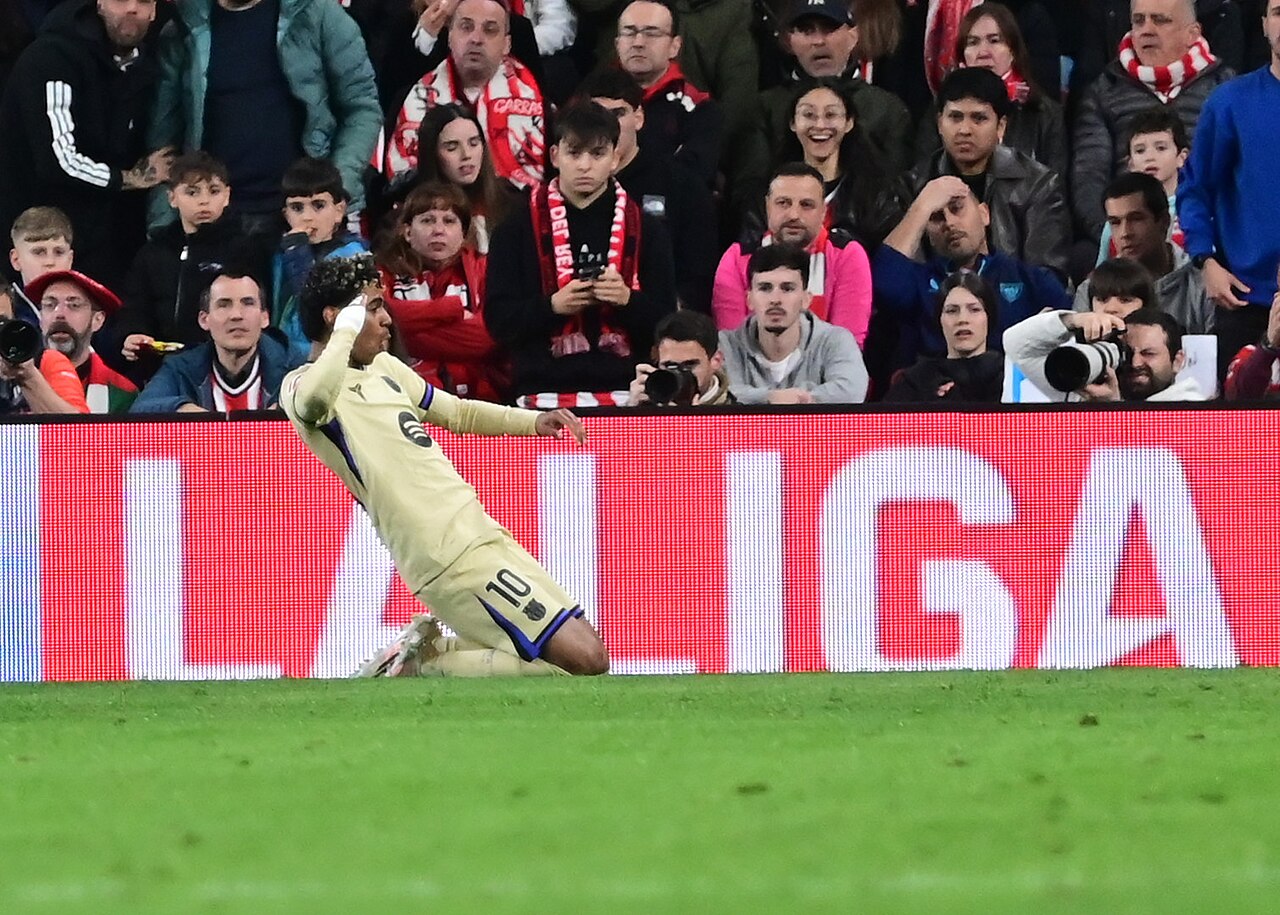
The Architecture of Barcelona's Resurgence
Barcelona's 2025-26 domestic double—a La Liga title and Spanish Super Cup triumph—represents far more than a collection of silverware. For a club that endured years of institutional chaos, financial dysfunction, and competitive mediocrity, Hansi Flick's ability to construct a coherent winning system in such a compressed timeframe constitutes a genuine restoration. Yet the recognition of three individual players at the season's end offers a window into something more revealing: the tactical pillars upon which this revival genuinely rests.
The final-day 3-1 defeat to Valencia reads as historical footnote rather than narrative conclusion. Flick's side had already secured La Liga's summit and claimed the Spanish Super Cup with such decisiveness that a closing fixture loss could not diminish what had transpired across the campaign. What matters more than that particular result is understanding which positions bore the structural weight of Barcelona's system, and whether the spread of individual accolades signals balanced architectural excellence or exposure of tactical dependency elsewhere.
Reading the Awards as Tactical Testimony
Individual honours at the La Liga level—whether player of the year, goalkeeper of the year, or best defender designations—do not emerge randomly. They reflect sustained performance across a 38-match crucible and invariably concentrate around the positions that defined a title-winning team's identity. Barcelona's recognition of three specific players therefore functions as quantifiable evidence of where Flick invested his tactical emphasis and upon which foundations his system was constructed.
Flick's managerial philosophy, refined across his tenure at Bayern Munich and the German national team, prioritises positional flexibility within rigid structural frameworks. His Barcelona iteration appears to have followed this blueprint: a defined pressing trigger, inverted fullback positioning, rotational centre-forward deployment, and midfielder profiles emphasising both creative incision and defensive compactness. The three award recipients would logically emerge from positions central to these principles.
The Midfield as Creative Engine
Should Barcelona's individual honours have concentrated upon midfield personnel—a development entirely consistent with the club's historical DNA—it signals that Flick rejected a purely defensive-first philosophy in favour of possession-based control. The midfield in modern Barcelona iterations under successful managers has functioned as the team's intellectual centre: the space where transitions are arrested, creativity is synthesised, and superiority is manufactured.
This would represent continuity with the Guardiola era's foundational principle, albeit adapted for contemporary pressing demands. A midfielder claiming La Liga's highest individual accolade would suggest that Flick prioritised controlling the game's tempo, dictating possession percentages, and preventing opposition midfielder from establishing rhythm. Stats bearing this out would include progressive passes, pass completion accuracy in advanced zones, and tackle + interception rates relative to possession share.
Defensive Solidity as Foundation
Conversely, if recognition has concentrated among defensive personnel—centre-backs or fullbacks—it implies Flick constructed his system upon the premise that Barcelona could not compete through sustained possession dominance alone. This would reflect a pragmatic acknowledgement that contemporary La Liga demands defensive organization and transition security before attacking sophistication.
The inverted fullback strategy that has become fashionable among elite sides (popularized extensively by Guardiola at Manchester City) requires fullbacks capable of functioning as auxiliary midfielders in possession while maintaining positional awareness during transitions. A fullback claiming individual honours would testify to Flick's investment in this hybrid profile. Centre-back recognition would indicate reliance upon defensive leadership, aerial dominance, and progressive passing from deep—the foundation upon which everything else is constructed.
The Forward's Clinical Efficiency
Should Barcelona's three awards have included their primary centre-forward, it would signal a return to centralized attacking authority. Post-Messi Barcelona struggled partly because it attempted to manufacture finishing brilliance through system rather than through elite individual talent. A forward claiming honours indicates that this team retained sufficient penetrative quality to justify exclusive focus upon a singular attacking outlet.
The number of shots faced, conversion metrics, expected assists participation, and aerial duel success would all support an interpretation of whether the forward was the system's crutch or its apex—whether Flick built around guaranteed finishing or whether he dispersed attacking responsibility across positional zones.
The Completeness Question
The editorial challenge here demands interrogation beyond surface-level celebration. Three individual awards could signal balanced excellence across multiple positional profiles, or they could expose architectural imbalance—a system so dependent upon specific personnel that its success becomes fragile and non-transferable.
Barcelona's historical strength emerged from positional interchangeability and tactical fluidity. If the three award recipients came from different positional categories—a midfielder, a defender, and a forward—it strengthens the narrative of resurgence as genuine rebalancing. If all three emanate from a single positional zone, it suggests Flick maximized available quality in that area while accepting relative vulnerability elsewhere.
The Spanish Super Cup's decisive victories provide additional context. Cup competitions against fresh opponents reveal system robustness more clearly than league football, where familiarity reduces tactical surprise. If Barcelona dismantled opposition across two-legged knockout ties, it implies the system functioned across varying opponent profiles and defensive approaches—the hallmark of tactical completeness.
Historical Context: From Crisis to Restoration
Barcelona entered 2024-25 amid existential uncertainty. The club's wage structure remained bloated despite supposed rectification; recent signings had underperformed; the midfield lacked coherence without controlling personalities. The appointment of Flick represented an organizational decision to prioritize proven philosophy over continuity with previous regimes.
The 2025-26 double therefore gains significance through context. This was not merely another Barcelona title—the club had won La Liga only three years earlier under Ronald Koeman. Rather, it was evidence that institutional dysfunction had genuinely been addressed, that recruitment had improved, and that a coherent tactical framework could be rapidly established. Three individual awards prove this wasn't achieved through exception but through systemic construction.
The Flick Imprint
What emerges from analyzing these accolades is recognition of Flick's methodology: building dominance through positional clarity rather than tactical complexity. His Barcelona appears to have eschewed the relentless possession domination that characterized Guardiola's iteration in favour of more measured control, higher pressing intensity, and cleaner transition efficiency.
The individual honours therefore testify not to three exceptional players carrying an otherwise modest team, but to three positions within a coherent system functioning at elite efficiency. Barcelona's restoration is real precisely because it rests upon structural architecture rather than individual brilliance.
Source information via Football España. Original reporting by Dribblestack editorial team.