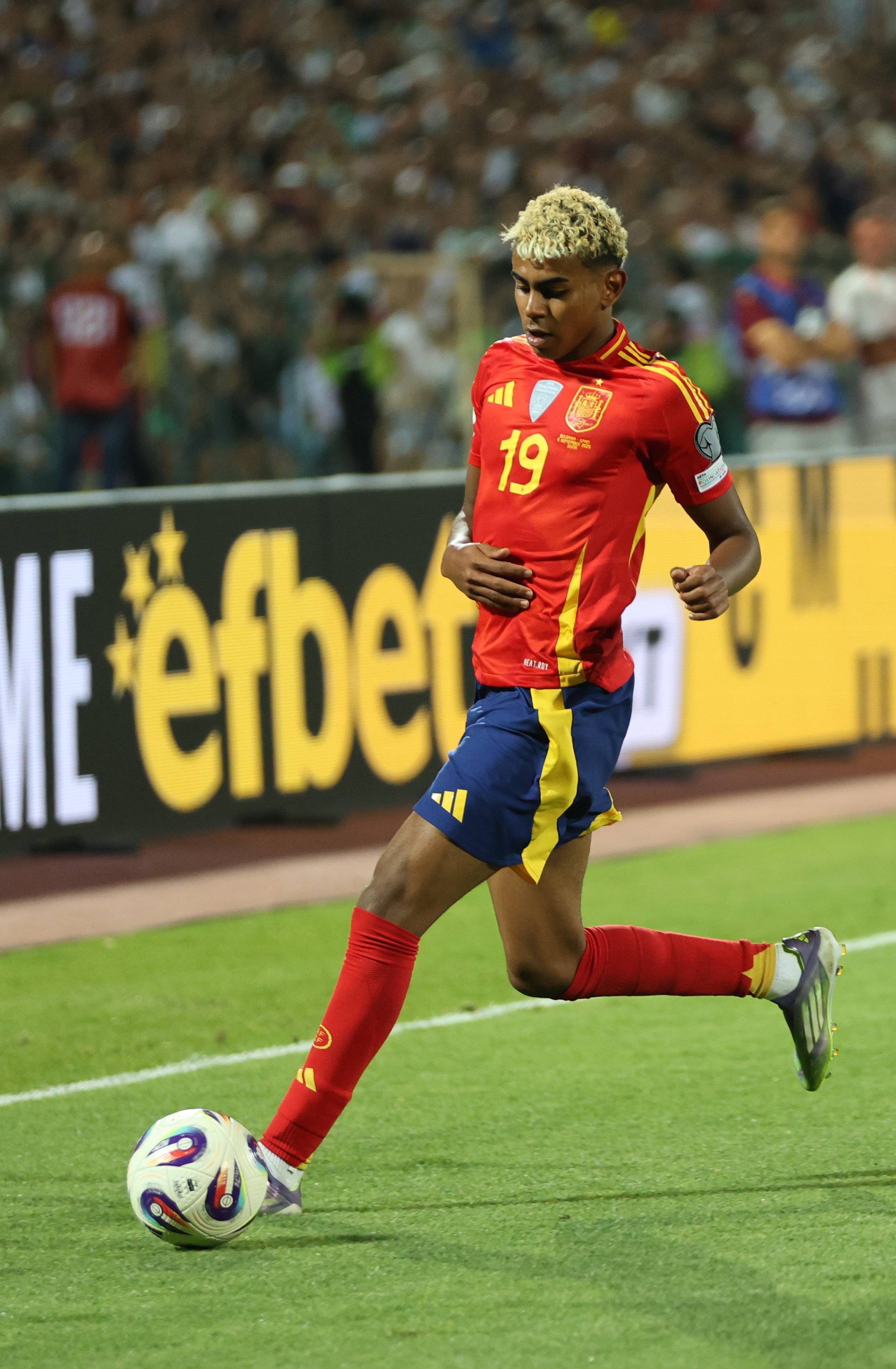
There is a specific, terrible second that every footballer dreads — the moment the body sends a signal the brain refuses to accept. The leg buckles, the stride breaks, and before the player has even hit the turf, the mind is already doing triage. For most professionals, that reckoning arrives after years of accumulated wear, of near-misses catalogued alongside the trophies. For Lamine Yamal, it arrived at seventeen.
In a video released by the Royal Spanish Football Federation (RFEF), Yamal described what went through his mind in the instant he felt his hamstring go. "I was praying internally that it wasn't anything," he said, "that it was a cramp or something, because the World Cup felt so close and I knew that a hamstring injury, even though I'd never had one before, I knew it wasn't going to be a short thing." That single sentence is worth unpacking at length, because it reveals something profound about the psychological landscape of elite sport — and about what it means to be a generational talent suddenly made aware of his own limits.
The Ignorance of the Indestructible
The most striking detail in Yamal's admission is not the fear itself but the specific gap in his knowledge. He had never suffered a hamstring injury before. At seventeen, playing at the absolute apex of club football, he had navigated the physical demands of elite competition without this particular education. That is, in one reading, a testament to his physical gifts — his body had simply not failed him in this way. In another reading, it is the most human thing imaginable: a teenager who had never needed to understand hamstring recovery timelines, because the subject had never applied to him.
This is the paradox of prodigies. The same freakish ability that fast-tracks them into elite environments also means they arrive without the protective scar tissue — physical and psychological — that older teammates carry. Veterans of the game know the particular dread of the hamstring because they have felt it, or watched teammates be undone by it, or sat through the physio's careful language about grade classifications and return-to-play protocols. Yamal had none of that reference library. What he had, in that moment on the pitch, was instinct — and instinct told him this was serious.
The Specific Architecture of His Fear
What separates Yamal's account from generic injury anxiety is the precision of his worry. He was not simply afraid of missing the World Cup. He was afraid of a very particular sequence of events: recovering quickly enough to make the squad, returning before he was truly ready, and then suffering a recurrence that would rule him out entirely. This is a sophisticated, almost clinical fear — the kind that suggests he had already done the research, spoken to medical staff, processed the information and arrived at the worst-case scenario with uncomfortable clarity.
The recurrence risk is statistically the central danger with hamstring injuries at the elite level. Studies across European football consistently show that re-injury rates for hamstring strains are among the highest of any soft tissue problem in the sport, particularly when players return within tight competitive windows under pressure. Yamal, apparently, understood this. He was not just afraid of the injury — he was afraid of the cure being rushed.
- The initial fear: That the injury would be severe enough to rule him out entirely from the start.
- The secondary fear: That the injury would seem manageable, triggering an accelerated return, only for the muscle to fail again under tournament conditions.
- The outcome he was praying for: Enough time, enough proper recovery, to arrive at the knockout stages of the World Cup whole.
That layered anxiety — not just will I miss it but will I make it back only to fall again — speaks to a maturity of self-awareness that is quietly staggering for someone his age.
What the Pitch Prayer Reveals Tactically
From a purely football-analytical standpoint, Yamal's absence from Spain's opening World Cup group games represents a measurable tactical disruption. Spain's system, built around rapid positional rotations, high press triggers and an assumption of quality on the ball in every corridor of the pitch, is calibrated in part around what Yamal provides on the right flank — the unpredictability, the acceleration into tight spaces, the ability to receive under pressure and immediately change the tempo of an attack.
No replacement replicates that. The honest tactical reality is that Spain in their opening games will be a slightly more predictable version of themselves — still formidable, still technically elite, but operating without their most destabilising creative force. The coaching staff will have prepared contingencies, and Spain's squad depth is not thin. But contingencies are by definition second choices.
The silver lining embedded in Yamal's own account is that the trajectory of his recovery, by the time of this video's release, pointed clearly toward the knockout rounds. He is accelerating his rehabilitation. The path is realistic. The goal is not just presence on the bench but genuine competitive availability — the kind that would allow him to be deployed from the start in a quarterfinal or beyond, when Spain may need their most dangerous player most urgently.
The Universal Moment Every Fan Recognises
Football has always been about the negotiation between what a player is capable of and what their body will permit. We watch from the stands or the sofa, and when a star player crumples to the turf we project onto them — we wonder what they're feeling, whether they know immediately how bad it is, what runs through a professional's mind in that suspended second before the medical team arrives.
Yamal has now answered that question directly, and the answer is disarmingly ordinary. He prayed. Internally, quietly, while still on the grass, he bargained with the situation — please let this be nothing, please let this be something small, please don't let this be the thing that takes the World Cup away. The prayer of a seventeen-year-old boy who had just glimpsed, for the first time, that even the most naturally gifted body on a football pitch is subject to the same breakable physics as everyone else's.
That is not weakness. That is the precise moment a footballer grows up. The ones who go on to define eras tend to carry that moment with them — not as a wound, but as knowledge. The awareness that brilliance must be protected, that invincibility is on loan, that the difference between a legendary career and a cautionary tale can sometimes be measured in the weeks a hamstring is given to heal properly.
Lamine Yamal learned that lesson at seventeen. The World Cup, if his recovery holds, may yet be where he demonstrates exactly what he did with it.
Source information via Mundo Deportivo. Original reporting by Dribblestack editorial team.